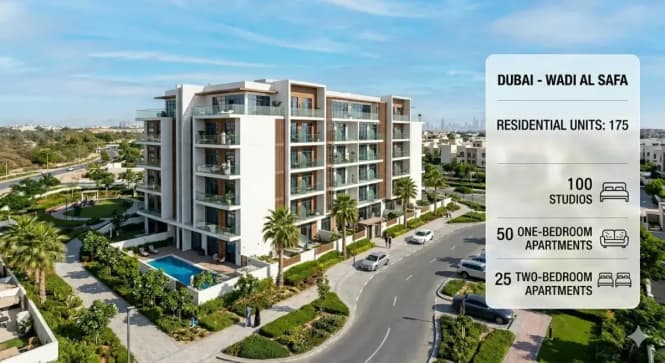
Commercial Residential Building for Sale | Wadi Al Safa Dubai
This commercial residential building for sale in Wadi Al Safa, Dubai is offered at AED 73,000,000 as a whole-asset acquisition — 175 residential units across three configurations, positioned directly in the demand corridor of Dubai Silicon Oasis and Academic City. The asking price implies an average of AED 417,143 per unit, with a required down payment of AED 14,600,000 at the standard 20% entry threshold. For investors evaluating Dubai commercial real estate at scale, the asset's composition — 100 studios, 50 one-bedroom apartments, and 25 two-bedroom apartments — is the variable that determines both the income ceiling and the operational complexity of ownership.
Buying a commercial building of this type in Dubai's eastern residential belt carries a different logic than acquiring individual units on the open market. The investor receives concentrated exposure to a single submarket with a predictable tenant profile, a managed common environment, and the operational leverage that comes from scale. Wadi Al Safa's villa-dominated streetscape has historically constrained apartment supply in the immediate area, which sets the absorption conditions a new project of 175 units enters into — and those conditions are structurally favourable for a well-priced residential asset at this location.
Asset Price, Down Payment, and Full Unit Breakdown
The AED 73,000,000 asking price covers the entire 175-unit building as a single commercial real estate transaction. The unit mix is the primary determinant of income structure: a majority studio allocation drives the gross yield profile, while the one-bedroom and two-bedroom units anchor the occupancy floor.
| Unit Type | Count | Share | Tenant Cohort |
|---|---|---|---|
| Studio | 100 | 57.1% | Single occupants, new arrivals, tech corridor workers |
| 1-Bedroom + Living | 50 | 28.6% | Couples, established professionals, long-term leaseholders |
| 2-Bedroom + Living | 25 | 14.3% | Small families, professional sharers, senior staff |
| Total | 175 | 100% | — |
What Purchasing This Commercial Building Means for the Acquiring Investor
At AED 73,000,000 for the whole asset, the acquiring party is effectively purchasing 175 income-producing residential units in a single transaction. The investment thesis rests on two compounding factors: the structural demand from the adjacent Silicon Oasis and Academic City employment corridors, and the limited competing apartment supply within Wadi Al Safa itself — a combination that supports occupancy rates and limits the pressure to discount rents to fill vacant units.
Income Architecture: Three Segments, Three Risk Profiles
The 100 studios carry the highest gross income yield percentage relative to their implied unit cost within the total asset price. They are, however, the highest-turnover segment: studio tenants in Dubai's mid-market tend to move at higher frequency than occupants of larger units, and each vacancy event typically costs one month of income plus agency re-letting fees of approximately 5% of annual contract value. A realistic occupancy assumption for the studio tranche is 90–93%, not 100%. The 50 one-bedroom units generate longer average tenancy durations and meaningfully lower re-letting frequency — renewal rates in this segment are structurally higher, which compresses the gap between gross and net yield. The 25 two-bedroom units produce the most predictable annual cash flow: tenants in this segment are typically settled professionals or small families who treat the unit as a two-to-three year home, generating the lowest per-unit management overhead in the building.
Scale Advantages of the 175-Unit Acquisition
Large commercial property acquisitions of this size — 175 units under single ownership — unlock operational efficiencies that individual unit purchases cannot. A building-level property management agreement can be negotiated at a significantly lower per-unit annual fee than a retail investor would pay for a single unit. Maintenance, common area upkeep, and service infrastructure are managed under a unified contract rather than fragmented across multiple owner-manager arrangements. For an investor building a UAE commercial real estate income portfolio, block-level ownership is the entry point at which per-unit operational costs begin to compress and cash flow predictability materially improves.
Exit Strategy Optionality
Whole-building ownership in a 175-unit residential asset in Dubai creates multiple exit pathways that individual unit holders do not have: en-bloc sale to another institutional buyer, strata subdivision and individual unit resale at retail pricing (which typically represents a premium over the en-bloc acquisition cost), or long-term hold with professional management generating compounding income returns. Each exit path has a different capital requirement timeline and tax treatment — the applicable conditions under UAE property regulations should be confirmed with a licensed real estate attorney before structuring the acquisition.
Current achieved rental rates per unit type from DXB Interact transaction records — not developer projections. Annual service charge rate per square foot and its three-year trend across the building. Existing tenancy status at the time of transfer: fully vacant, partially occupied, or fully tenanted — each scenario carries different cash flow implications from day one. Freehold classification of the specific plot via Dubai Land Department (DLD) records. Developer delivery track record if the asset is off-plan. Legal structure of the whole-building transfer and applicable DLD registration fees.
Wadi Al Safa, Dubai: Why This Location Supports the Income Thesis
Commercial real estate in Dubai's eastern residential belt derives its investment durability from employment proximity rather than lifestyle branding. Wadi Al Safa's demand is generated by a working population that needs housing near its place of work — a more structurally stable demand source than leisure-adjacent or tourism-dependent submarkets.
Wadi Al Safa runs along Mohammed Bin Zayed Road (E311), one of Dubai's main arterials connecting northern and southern districts. The neighbourhood developed as a villa and townhouse community, which has historically kept mid-rise apartment stock limited relative to the density of the surrounding population. A 175-unit building entering this environment faces thinner competing supply than it would in JVC, Al Barsha, or Dubailand — and that supply constraint directly supports absorption pace and achieved rent levels at the time of launch and beyond.
Dubai Silicon Oasis to the east and Academic City to the north collectively generate the tenant base this building is structurally designed to serve: technology workers, free zone employees, university staff, logistics operators, and postgraduate students — all groups who represent the natural demand for studios and one-bedroom apartments at mid-market price points. Employment-anchored demand does not contract during the same cycles that affect leisure or tourism-dependent submarkets. This makes it a more reliable foundation for a three-to-seven year income hold than assets positioned in areas dependent on transient or discretionary-spending populations.
What Investors Ask Before Buying This Building
What is the asking price for this commercial residential building for sale in Wadi Al Safa, Dubai?
The whole-asset asking price is AED 73,000,000 for all 175 residential units. The implied average per-unit cost across the full building is AED 417,143. The standard down payment at 20% of the purchase price is AED 14,600,000, with the balance subject to agreed payment terms or financing structure.
Is this a whole-building sale or can individual units be purchased separately?
This is offered as a whole-asset commercial real estate transaction — one buyer acquires all 175 units as a single registered block. Individual unit sales are not part of this listing. Buyers interested in sub-dividing and reselling at strata level post-acquisition should confirm the legal and regulatory requirements for strata title registration with Dubai Land Department (DLD) before structuring the deal.
What is the required down payment for purchasing a commercial building in Dubai at this price level?
At the standard 20% down payment threshold, the required upfront equity for this AED 73,000,000 asset is AED 14,600,000. Commercial and whole-building transactions in Dubai may carry different financing conditions than individual residential unit mortgages — buyers should confirm applicable loan-to-value ratios and financing eligibility with a UAE-licensed commercial bank or mortgage broker before proceeding.
How many units does the building contain, and what is the unit mix?
The building contains 175 residential units: 100 studios (57.1%), 50 one-bedroom apartments with living area (28.6%), and 25 two-bedroom apartments with living area (14.3%). The studio-heavy composition targets the single-occupant rental market generated by the Silicon Oasis and Academic City employment corridors adjacent to Wadi Al Safa.
What gross rental income can a 175-unit residential building in Wadi Al Safa realistically generate?
Gross income depends on achieved rental rates per unit type — which require current market comparables from DXB Interact transaction records rather than developer projections. As a framework: at 90% occupancy across all 175 units (157–158 units producing income), gross annual income is a function of the weighted average rent per unit size. Net income after service charges, management fees, re-letting costs, and maintenance will be materially lower. A licensed property management firm active in the Wadi Al Safa submarket is the most reliable source for defensible pro-forma projections before commitment.
Is Wadi Al Safa freehold for foreign investors, and how does that affect the whole-building acquisition?
Wadi Al Safa contains both freehold-designated and non-freehold plots — the area is not uniformly classified. For a whole-building acquisition, confirming freehold status of the specific plot number through DLD records is non-negotiable: it determines whether full ownership rights can be transferred to a non-GCC national or corporate entity. This verification must be completed before any funds change hands, regardless of how the developer describes the project in marketing materials.
What exit strategies are available after purchasing a 175-unit commercial building in Dubai?
Three primary exit pathways exist: en-bloc resale to another institutional or private buyer at a negotiated whole-asset price; strata subdivision and individual unit resale at retail pricing, which typically yields a premium over the en-bloc acquisition cost per unit; or long-term income hold with professional property management generating compounding returns. Each pathway has distinct regulatory, tax, and timing requirements under UAE real estate law — legal structuring advice from a licensed UAE property attorney is essential before the acquisition closes if a specific exit is part of the investment plan.
How does buying a large commercial building in Wadi Al Safa compare to acquiring individual units across multiple Dubai projects?
A single large-scale commercial real estate acquisition of 175 units offers unified ownership, one transfer registration, and block-level property management at compressed per-unit operational cost. The trade-off is concentration risk: the entire capital position is exposed to one submarket, one building's physical condition, and one management operation. Investors distributing capital across multiple projects or locations hold geographic diversification, but pay retail per-unit prices and manage multiple service relationships. Which structure suits a given investor depends on capital available, management capacity, and portfolio construction objectives — neither is categorically superior.
Does purchasing this Wadi Al Safa building support a UAE Golden Visa or investor residency?
UAE investor residency visa thresholds and qualifying property structures are set by federal and emirate-level regulation and are subject to legislative change. At AED 73,000,000, this asset substantially exceeds current published thresholds for property-linked residency programmes — but visa eligibility for a corporate entity versus an individual buyer, and for a whole-building transaction versus a direct title transfer, may be treated differently under applicable rules. Current eligibility should be confirmed with the Federal Authority for Identity and Citizenship (ICA) or a licensed UAE immigration consultant before treating residency as part of the investment rationale.
What due diligence is required before completing a whole-building commercial real estate purchase in Dubai?
Six steps are non-negotiable at this acquisition scale: confirm freehold status of the plot through DLD using the developer-provided plot number; obtain current rental comparables per unit type from DXB Interact; review the three-year service charge history and any reserve fund position; verify the developer's delivery record against stated timelines if off-plan; conduct a physical building survey or snagging report if the asset is complete; and engage a UAE-licensed real estate attorney to review the sale and purchase agreement, ownership structure, and DLD transfer documentation before execution. Shortcutting any of these steps at AED 73,000,000 creates legal and financial exposure that cannot be recovered post-transfer.