UAE Property Investment: 6–8% Yields, Strong Banking & Stability
Every serious allocation decision comes down to the same calculus: what return does the capital generate, how protected is the principal, and what does the exit look like? The UAE property market answers all three with numbers that hold up under scrutiny — which is why it has pulled in institutional and private capital from over 200 nationalities without relying on a single wave of promotional hype.
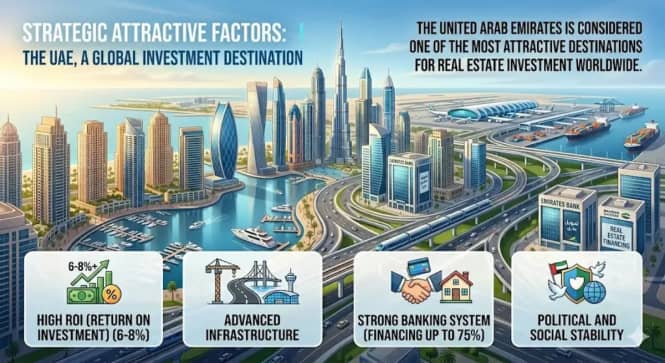
UAE real estate delivers annual rental yields of 6–8%, more than double the sub-3% figures recorded in London and New York. Banks here finance up to 75% of a property's value over repayment periods extending to 25 years — giving foreign investors genuine leverage at a market entry point that would require far deeper equity in most comparable cities. A consistently high global safety ranking and a transparent freehold ownership framework complete the picture.
Key Investment Metrics at a Glance
| Market | Rental Yield | Mortgage Access (Foreign Buyers) | Political Stability |
|---|---|---|---|
| UAE | 6% – 8% | Up to 75% LTV | Very High |
| London | Under 3% | Restricted for non-residents | High |
| New York | Under 3% | Complex requirements | High |
What the Numbers Mean for Your Decision
ROI: Reading Yield Figures with Precision
The 6–8% range is a market average, not a guarantee attached to every unit in every postcode. Studios and one-bedroom apartments in high-demand corridors — JVC, JLT, Deira — consistently track toward the upper end of that band because purchase prices remain lower relative to achievable rents. Three-bedroom and larger units tend to deliver a lower yield percentage but compensate with longer-tenancy stability and lower vacancy risk. Net yield, after service charges, is always the figure that matters.
- Service charges typically range from AED 10–30 per sq ft annually, depending on the developer and project — subtract these before comparing yields across markets.
- Capital appreciation is a separate return vector. Prime waterfront and downtown addresses have historically outperformed on price growth while offering relatively moderate yields.
- New launches often command premium prices; the sharpest yields frequently come from established mid-market stock bought below replacement cost.
The Mortgage Advantage: What 75% LTV Actually Unlocks
A 75% loan-to-value ratio means a foreign buyer can enter a AED 2,000,000 property with AED 500,000 in equity. Stretched over 25 years, monthly debt service is contained enough to remain cash-flow positive on a 6%+ yield asset — a structural advantage that is difficult to replicate in markets where non-resident mortgage access is either capped at 60% or unavailable altogether. The trade-off: UAE banks scrutinize income stability, credit history, and residency status closely, and non-resident applicants typically face tighter documentation requirements than residents. Comparing offers from a minimum of three lenders before committing is not optional advice — it is arithmetic.
Tax Environment: The Net Yield Multiplier
The UAE levies no personal income tax and no capital gains tax on property profits. In practical terms, a 7% gross yield in Dubai is closer to a 7% net yield for most individual investors — a comparison that inverts sharply against markets like the UK, where income tax on rental profits and capital gains tax at exit can reduce a 4% gross yield to 2.5% or less in the hands of a higher-rate taxpayer. This tax efficiency is structural, not promotional, and it materially changes the ROI calculus for internationally mobile capital.
The Visa Angle: Residency Through Property
A property purchase of AED 750,000 or above qualifies investors to apply for a UAE investor residency visa. The Golden Visa — a 10-year renewable residency — targets investments at AED 2,000,000 or higher. Both thresholds are subject to the specific terms set by UAE authorities at the time of application, and conditions are updated periodically. For investors who plan to spend significant time in the region or wish to establish UAE tax residency, this pathway changes the property from a financial asset into a lifestyle infrastructure decision as well.
- Verify actual occupancy rates in the target sub-market — not the headline city average.
- Request the current service charge schedule from the developer or owners' association.
- For off-plan purchases, review the developer's track record on handover dates across previous projects.
- Compare mortgage offers from at least three banks before selecting a lender.
- Confirm the freehold status of the specific plot and building with the Dubai Land Department (DLD).
Why Geography and Legal Infrastructure Drive Sustained Demand
The UAE sits at the intersection of three continents — with Dubai International Airport (DXB) among the world's busiest by international passenger volume, and Abu Dhabi International handling a growing share of regional transit. This geographic position sustains a large, multi-national expatriate population with consistent housing demand across a wide price spectrum, independent of any single nationality's appetite. It is structural demand, not cyclical — and it underpins the rental yield floor that the market has maintained through multiple global economic cycles.
On the legal side, freehold ownership zones grant foreign nationals outright, perpetual title to property — registerable with the Dubai Land Department and enforceable under UAE law without time limits. This is categorically different from leasehold structures common in other Gulf markets. The transparency of the DLD registration system, including public availability of transaction prices, gives investors verifiable comparable data that is rare in the region and reduces the information asymmetry that inflates risk premiums elsewhere.
Infrastructure investment continues to extend the demand catchment area. The planned expansion of Al Maktoum International Airport (DWC) toward a target capacity of 260 million passengers annually is the largest aviation infrastructure project globally by some measures. Areas within the southern Dubai growth corridor — already in motion — represent a category of infrastructure-led appreciation that the market is still early in pricing.
Frequently Asked Questions
Is UAE real estate a good investment in 2026?
The fundamentals that have driven performance — yield premium over comparable global markets, demographic-driven rental demand, zero income and capital gains tax, and freehold legal infrastructure — remain intact. The risks worth tracking are supply pipeline growth in specific sub-markets and the trajectory of global interest rates, which affect financing cost. On balance, the structural case holds, though entry point and asset selection matter significantly more than they did in the pre-2020 market.
How does UAE property compare to London or New York for ROI?
On gross yield, UAE residential property at 6–8% outpaces both London and New York, which typically return under 3%. The gap widens further on a net, after-tax basis: the absence of rental income tax and capital gains tax in the UAE means the headline gross yield is close to what the investor actually keeps. In London or New York, higher-rate taxpayers can see effective net yields fall to half the gross figure after tax obligations are accounted for.
What is the maximum loan-to-value ratio for a foreign buyer in the UAE?
Foreign non-resident buyers can typically access up to 75% LTV on completed residential properties, requiring a 25% down payment. Residents generally access the same ceiling, subject to income and credit criteria. For properties priced below AED 5,000,000, the 75% LTV ceiling applies in most cases; above that threshold, some lenders apply a lower cap. Terms vary between institutions — a mortgage broker comparison across three or more banks is the practical starting point.
Are there property taxes or capital gains taxes in the UAE?
There is no annual property tax, no rental income tax, and no capital gains tax on property in the UAE for individual investors. A one-time Dubai Land Department transfer fee of 4% applies at the point of purchase, and a 2% agency commission is standard. Ongoing costs are limited to service charges, which vary by building and developer. This tax structure is a material driver of net yield comparisons with European or North American markets.
What is the minimum investment for a UAE Golden Visa through property?
The Golden Visa threshold through real estate is AED 2,000,000 in property value. A standard investor visa is available at AED 750,000. Both figures are subject to the eligibility conditions and procedural requirements set by UAE immigration authorities at the time of application, and the details are updated periodically. Anyone using the property purchase as a visa pathway should confirm current requirements directly with the Federal Authority for Identity, Citizenship, Customs and Port Security (ICP).
Does UAE political stability actually protect foreign property investors?
Political stability does two things for asset prices: it reduces the risk premium that global capital demands when pricing real estate, and it maintains the continuity of the legal and regulatory framework that protects ownership rights. The UAE's consistent governance record means property law, freehold regulations, and DLD registration procedures have remained stable across multiple decades — a track record that is demonstrably reflected in continued foreign capital inflows even during periods of regional geopolitical stress.
What should I check before buying an investment property in the UAE?
Five things warrant verification before any commitment: the actual rental yield and occupancy data for the specific sub-market (not the city-wide average); the annual service charge per square foot for the building; the developer's delivery history on previous projects if buying off-plan; mortgage terms from multiple lenders rather than accepting the first offer; and the freehold status of the unit confirmed with the Dubai Land Department. Missing any one of these can materially change the investment's performance relative to the headline figures.
Which areas of Dubai offer the strongest rental yields for investors?
Jumeirah Village Circle (JVC), Jumeirah Lakes Towers (JLT), and Deira consistently appear at the upper end of yield rankings, primarily because purchase prices remain lower relative to achievable rents in these areas. Downtown Dubai and waterfront locations tend to produce stronger capital appreciation but at lower yield percentages. There is no universally "best" area — the right choice depends on whether the priority is immediate income generation or longer-term price growth, and on the buyer's tolerance for management intensity and vacancy risk.