Profitable Real Estate Investment Strategies in Dubai
Dubai real estate delivers gross rental yields between 5% and 9% across its main residential districts — a figure that looks attractive in isolation but tells you nothing about which of the seven available investment models fits your capital position, risk appetite, or time horizon. The decision of how to invest matters as much as the decision to invest. This guide breaks down each strategy with the numbers and conditions a serious buyer needs to evaluate it honestly.
What makes Dubai a credible market for international investors is not just yield — it is the legal infrastructure. Freehold ownership for foreign nationals is established in designated zones covering most of the city's major investment areas. Properties priced at AED 2 million and above qualify for the UAE Golden Visa, a 10-year renewable residency that changes the calculus for longer-hold strategies. Understanding where each investment model intersects with these structural advantages is where advisory value lives.
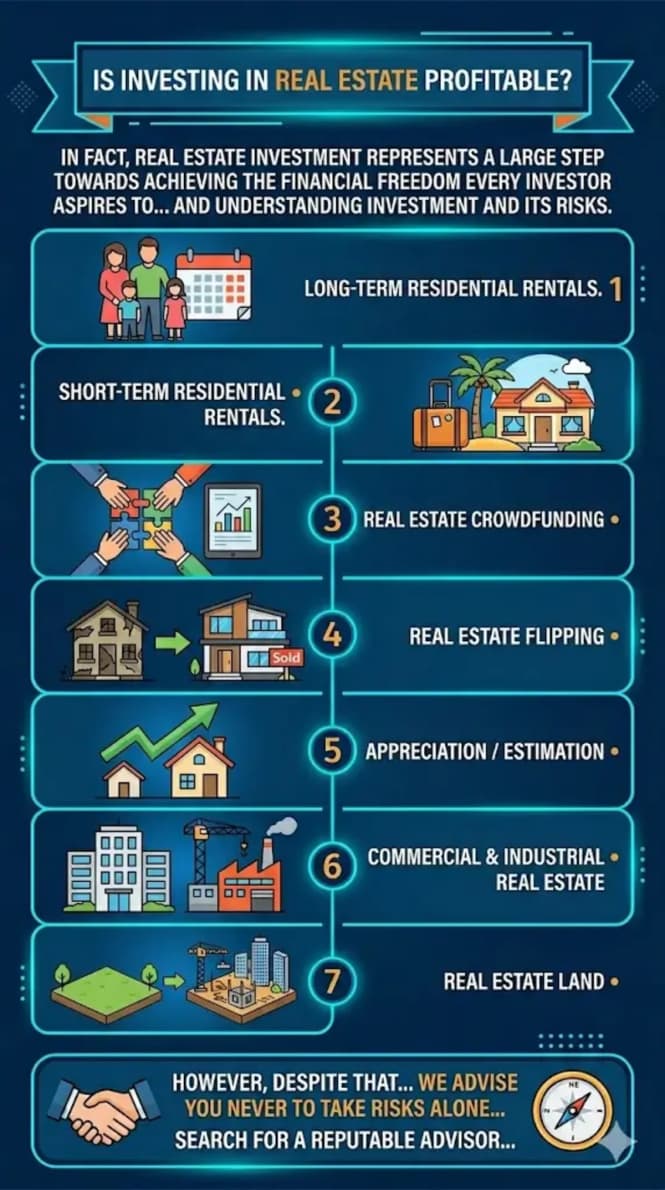
Seven Real Estate Investment Strategies in Dubai: Risk-Return at a Glance
The cards below summarize the landscape. Returns are indicative ranges based on market data — actual outcomes depend on asset selection, entry price, and management quality. No strategy delivers these figures automatically.
Long-Term Residential Rental in Dubai: Building a Predictable Income Foundation
Long-term residential rental is the entry point most individual investors gravitate toward — and with good reason. Demand for housing in Dubai is structural, driven by a growing expatriate population and limited affordable supply in well-located districts. The city's population growth has consistently outpaced the delivery of new residential inventory in core zones.
What the headline yield figure does not show: net yield after costs is materially lower than gross. Property management fees in Dubai run between 8% and 12% of annual rent, service charges vary from AED 10 to AED 35 per square foot depending on the development, and vacancy between tenancies erodes further. A unit advertising a 7.5% gross yield may deliver 4.5%–5.5% net — still competitive by global standards, but the input number that belongs in your financial model.
Location selection matters more here than in any other strategy. Districts with sustained occupancy and rent growth — Jumeirah Village Circle, Dubai Sports City, Damac Hills 2 — offer higher yields than prime waterfront areas like Dubai Marina or Palm Jumeirah. However, the tenant quality and payment reliability in premium zones is demonstrably stronger, which is a risk-adjusted consideration that does not show up in yield percentages.
Short-Term Rentals and Holiday Homes: Higher Yield Ceiling, Higher Operating Complexity
Dubai's short-term rental market expanded significantly post-2021, supported by record tourist arrivals and the city's positioning as a global business hub. Beachfront locations — Palm Jumeirah, JBR, Dubai Marina — consistently achieve the highest occupancy rates and the strongest nightly rates, which is where the gross yield premium over traditional leasing is most defensible.
The legal baseline: operating a short-term rental in Dubai requires a valid permit from the Department of Economy and Tourism (DET). This is non-negotiable and inspections do occur. Operating costs are substantially higher than conventional letting: cleaning between stays, multi-platform booking management, more frequent maintenance, and the platform commissions themselves. Short-term rental management companies typically charge 20%–30% of gross revenue. Factor that into any pro forma before comparing headlines.
Realistic occupancy for well-run units in high-demand locations runs between 65% and 80% across a full year — not 100%. The summer months (June through September) consistently see lower demand. An investor entering this model needs a liquidity buffer to cover operating costs through seasonal soft periods without being forced into suboptimal decisions on pricing or management.
Real Estate Crowdfunding in the UAE: Licensed Platforms and What Investors Should Verify
The UAE's regulatory framework for real estate crowdfunding has matured, with the Securities and Commodities Authority (SCA) having issued licences to platforms operating fractional ownership models. The proposition: invest in a share of a vetted property, receive proportional rental income, and participate in exit proceeds when the asset is sold — without the capital commitment or management burden of direct ownership.
The genuine advantages are capital efficiency and diversification. An investor can spread exposure across multiple assets in different locations for a fraction of the cost of a single direct purchase. The constraints are equally real: liquidity is limited — you cannot exit a fractional position on demand the way you can sell a listed security — and you have no meaningful influence over asset management decisions, renovation choices, or the timing of a sale.
Before committing to any platform, verify its SCA licence status independently, read the exit mechanism in full rather than the summary, and understand the projected hold period. Crowdfunding in real estate is a medium-to-long horizon instrument, not a liquid alternative to equity investing.
Property Flipping in Dubai: Calculating Whether the Numbers Actually Work
Flipping — buying a distressed or undervalued property, renovating it within a defined period, and reselling at a premium — generates compelling returns in a strongly rising market. The model's profitability is not consistent; it is cyclical and highly sensitive to entry price accuracy and renovation cost control.
The full cost stack that must precede any purchase decision: DLD transfer fees at 4% of purchase price, agency commission at 2%–2.5%, actual renovation costs confirmed by post-inspection estimates (not pre-purchase guesses), resale agency fees, and the holding cost during renovation and marketing. In Dubai, a two-bedroom apartment renovation to a market-grade finish typically runs between AED 80,000 and AED 150,000 depending on original condition and target specification. That number belongs in the model before you sign, not after.
Flipping works with reliable frequency during periods of strong market appreciation. In a stable or moderately moving market — which Dubai has more often resembled in recent periods — the error margin is narrow and exits on underperforming renovations can be painful. The strategy requires hyperlocal knowledge of values and proven relationships with contractors who deliver to budget.
Capital Appreciation Strategy: Buying Ahead of Infrastructure and Demographic Demand
This model is built on identifying assets in locations where structural demand drivers — new infrastructure, rezoning, population spillover from adjacent districts — will increase values over a defined hold period. It requires a longer time horizon than yield-driven strategies but has historically produced the strongest total returns for investors who timed entries correctly.
Off-plan property is the primary instrument for this strategy in Dubai. Buying at launch price and holding through completion captures the appreciation that has historically sat between 15% and 40% in projects backed by established developers in strong locations. This is not a guaranteed spread — it is an outcome produced by specific conditions: developer credibility, precise location within a growing district, and a market cycle that supports absorption at the point of delivery.
For Golden Visa eligibility, an off-plan purchase qualifies when the property value reaches AED 2 million, whether purchased outright or through a mortgage with a minimum AED 2 million own-contribution. This residency dimension fundamentally changes the hold-versus-sell calculation for many international buyers, particularly those using Dubai as a base for regional operations.
Commercial and Industrial Real Estate: Institutional-Grade Returns, Institutional-Grade Requirements
Commercial property in Dubai — Grade A offices in DIFC and Business Bay, logistics warehousing in Dubai South and Al Quoz, retail strip in established mixed-use developments — offers lease yields in the 7%–10% range underpinned by 3-to-10-year tenancy agreements. The income profile is substantially more predictable than residential simply because commercial tenants do not vacate frequently.
The structural trade-off: capital requirements are significantly higher, and the asset class is more exposed to macroeconomic cycles. When business confidence softens, office and retail demand contracts faster and deeper than residential demand does. Lease terms in commercial real estate also contain nuances — break clauses, fit-out contribution obligations, rent review mechanisms — that require specialist legal and advisory input before commitment. This is not a category where surface-level yield analysis is sufficient.
Land Banking in Dubai: Long-Horizon Conviction With No Income Cushion
Vacant land and early-stage development plots represent the highest-risk, highest-potential-upside position in Dubai's real estate spectrum. The historical pattern is established: plots acquired in proximity to announced infrastructure projects — metro extensions, new freeway interchanges, master-planned development zones — have delivered multiples of purchase price over 5-to-10-year holds when the development thesis played out.
The factors that determine whether a land investment thesis holds: the zoning classification and permitted development rights, the realistic timeline before infrastructure delivery, and whether self-development or resale is the intended exit. Critically, land generates no rental income during the hold period. The investor carries the full cost of capital — or the opportunity cost of it — for however many years it takes for the value event to materialise. That carrying cost must be sized against the projected upside with honest assumptions, not optimistic ones.
Pre-purchase due diligence on land is more complex than on built assets. Verify permitted floor area ratio, confirm utility connectivity status, and check for any encumbrances or master-plan restrictions that affect buildable density. The returns are real when the conditions are right; so are the losses when they are not.
The most consistent differentiator between investors who build durable wealth in Dubai real estate and those who do not is not capital — it is team quality. Before committing to any strategy, build the right professionals around you: a licensed real estate adviser with a verifiable track record in the specific market segment you are targeting, a UAE-qualified lawyer for contract review, and a tax adviser in your country of residence who understands the cross-border implications of UAE property ownership.
The adviser relationship that has the most value is not the one that finds you a property — it is the one that prevents you from buying the wrong one. That service looks different from a sales pitch, and it is worth paying for separately from the transaction.
Frequently Asked Questions: Real Estate Investment in Dubai
What is the average gross rental yield for residential property in Dubai?
Gross rental yields in Dubai's main residential districts range from 5% to 9% annually, with higher-density affordable communities like JVC and Dubai Sports City sitting at the upper end and prime waterfront areas like Palm Jumeirah at the lower end. Net yield after management fees, service charges, and vacancy typically runs 1.5 to 2.5 percentage points below the gross figure. These ranges reflect market data from established communities — new or peripheral locations may sit outside them in either direction.
Does buying property in Dubai qualify for the UAE Golden Visa?
Yes. A property valued at AED 2 million or more — purchased outright or through a mortgage with a minimum AED 2 million own-contribution — qualifies the buyer for a 10-year renewable UAE Golden Visa. The visa covers the primary holder, spouse, and dependents, and does not require continuous residency in the UAE to maintain. Off-plan properties qualify once the purchase price meets the AED 2 million threshold, regardless of completion status.
What is the minimum investment for real estate crowdfunding in the UAE?
Minimum investment thresholds on UAE-licensed crowdfunding platforms vary by operator but commonly start from AED 500 to AED 5,000 per position, making this the lowest capital-entry point for direct real estate exposure in the market. The SCA-regulated platforms are required to disclose their licence status, fee structures, and projected hold periods — verify each of these before investing rather than relying on platform marketing materials alone.
How does off-plan property compare to ready property as an investment in Dubai?
Off-plan property offers lower entry prices, phased payment plans that reduce upfront capital commitment, and the potential for capital appreciation between purchase and delivery — typically a 2-to-4-year window. Ready property delivers immediate rental income and eliminates construction and delivery risk. The trade-off is structural: off-plan prioritises capital growth over income, ready property prioritises income stability. Which fits better depends on whether your investment thesis is yield-driven or appreciation-driven.
What due diligence should I complete before buying an investment property in Dubai?
At minimum: verify the title deed is clean and unencumbered through DLD's Dubai REST platform, confirm service charge history and outstanding payments, review the strata accounts for the building or community, inspect the physical unit before contract exchange, and for off-plan purchases confirm the escrow account registration number with DLD directly. Engaging a UAE-qualified property lawyer for contract review adds a layer of protection that consistently outweighs its cost, particularly for non-resident buyers unfamiliar with the SPA structure.
What are the total transaction costs when buying real estate in Dubai?
The primary cost is the DLD transfer fee of 4% of the property purchase price, paid at title transfer. Add an administrative fee of approximately AED 4,000–5,000, DLD registration fees, and — if using a real estate broker — an agency commission of 2% to 2.5%. For mortgage buyers, bank arrangement fees and property valuation costs apply on top. Total transaction costs for a straightforward cash purchase typically land between 5% and 6% of the purchase price, which must be accounted for in any break-even analysis on resale.
Is rental income from Dubai property subject to tax?
The UAE imposes no income tax on rental income earned by individual property owners, and there is no capital gains tax on property sales in the UAE. However, your country of tax residence may treat Dubai rental income and capital gains as taxable under its domestic rules — this is the jurisdiction that matters for most international investors. Confirming your cross-border tax position with a qualified adviser in your home country before purchasing is not optional for structuring an investment correctly.
What is the typical exit strategy for a real estate investment in Dubai?
The three primary exit routes are: open-market resale through a licensed agent, resale to another investor within the same development (common in off-plan secondary markets before completion), and refinancing to extract equity while retaining the asset. The Dubai secondary market is liquid by regional standards, particularly in established communities with strong transaction volumes. Exit timing relative to the market cycle, remaining mortgage terms, and service charge standing all affect net proceeds — plan your exit before entry, not after.