12 Real Estate Investment Tips for Dubai Market
Every investor who enters the Dubai property market faces a version of the same question: how do I make a decision I won't regret in three years? Not every purchase is a sound investment, and the gap between a performing asset and a poorly bought one often comes down to process — not luck. These 12 principles are drawn from direct market observation, not from a textbook.
Dubai's property market recorded transaction values exceeding AED 400 billion in 2024 according to Dubai Land Department (DLD) data, with active buyers from more than 180 nationalities. Volume and diversity of this scale signal genuine structural demand — but they also mean competition is real, prices in high-demand areas reflect that competition, and distinguishing a genuine buying opportunity from marketing noise requires a disciplined framework.
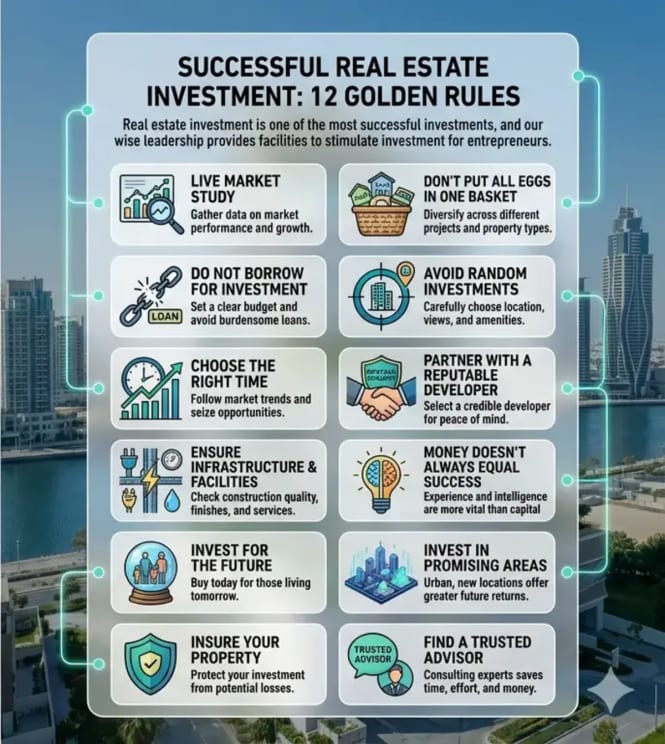
12 Principles That Separate Informed Investors from Reactive Ones
Each principle below addresses a specific failure mode common among first-time and repeat investors in the Dubai property market. They are sequenced by phase — from pre-purchase research through to asset protection.
-
Study the market with live data, not general impressions
Before committing capital, build a factual picture of the sub-market you're targeting: historical price movement, transaction volumes, current supply pipeline, and realistic yield ranges. DLD's open transaction data is a starting point. Single-source research — especially from developers' own materials — produces a skewed picture. Patience grounded in data is not hesitation; it is discipline.
-
Diversify across property types and communities
Concentrating capital in a single unit, building, or community creates unnecessary exposure to localized corrections. A portfolio balanced across property types — apartment and villa, for instance — and across communities at different maturity levels provides more stable aggregate performance across market cycles than a single large bet.
-
Do not finance your investment with borrowed capital
Using debt to fund a speculative property purchase converts a potential asset into a guaranteed liability. Interest obligations and monthly repayments constrain your flexibility precisely when markets correct and options are most valuable. Structure your investment around capital you actually hold, and maintain a liquidity reserve covering at least six months of carrying costs.
-
Define your investment criteria before searching — not during
Investors who begin searching without predetermined criteria — maximum price, target location, property type, minimum yield threshold — make worse decisions under pressure. Write your criteria down before you attend a single viewing. A property that meets nine out of ten criteria is worth evaluating; one that meets five is not, regardless of how the pitch sounds.
-
Time entry against the market cycle, not against FOMO
Dubai's property market moves in readable cycles: periods of sharp appreciation, followed by a correction phase, followed by stabilization. Buying during peak sentiment typically means paying a premium that takes years to recover. Track supply and absorption data consistently — entry during stabilization or early-recovery phases typically produces better 5-year outcomes than entry at cycle peaks.
-
Select developers on verified delivery record, not branding
A developer's marketing budget has no bearing on their ability to deliver on time and to specification. Before committing to an off-plan purchase, verify the developer's registration with DLD, review their completed project history against announced timelines, and read buyer feedback from independent forums — not the developer's own channels.
-
Verify infrastructure quality against the asking price
Pricing should reflect actual finishing quality and the real infrastructure surrounding the unit: transport access, schools, healthcare, and green space. A unit priced at a premium must justify that premium with verifiable specifications and proximity to demand drivers. If you are buying off-plan, commission an independent technical review at key construction milestones.
-
Market knowledge compounds faster than capital alone
A large budget managed without market knowledge will find its way into poor transactions. The most expensive mistakes I have observed in this market were made by well-capitalized buyers who did not understand what they were buying — or why a seller was willing to part with it at that price. Invest in your understanding of the market before you invest your money.
-
Set a long investment horizon and build toward it
Property purchased today near a new metro station, a planned free zone, or an infrastructure corridor will typically reflect that infrastructure in its price before the project completes. The appropriate holding horizon for residential investment in Dubai is 5 to 10 years. Investors who exit within 2 years often do so at break-even or below after transaction costs.
-
Target communities with demonstrable growth drivers
Location determines more of a property's long-term ROI than any other variable. Emerging communities — Dubai South near Al Maktoum International Airport, areas adjacent to Expo City Dubai, and freehold zones undergoing active master-planning — offer better entry valuations relative to their future demand potential than fully mature communities where price appreciation has already been priced in.
-
Insure the asset — without exception
Property insurance in Dubai is one of the lowest-cost risk mitigations available relative to the asset value it protects. Typical annual premiums range between 0.1% and 0.2% of the property's value. Building insurance is mandatory when a mortgage is in place; for outright-owned assets, it is not legally required but is financially irrational to skip.
-
Engage a specialist advisor, not just a listing agent
A listing agent's incentive is to close a transaction — any transaction. A specialist real estate advisor's value lies in telling you which transactions to avoid. The distinction matters: the advisor's fee is an investment in better decision-making; the agent's commission is a cost of a specific deal. Seek someone with a verifiable track record across completed transactions in your target segment.
What Separates a Performing Dubai Investment from a Losing One
In reviewing dozens of property transactions across Dubai and the Gulf, the difference between profitable and distressed outcomes concentrates around three variables — not luck, not timing, and not market conditions alone.
On information quality
The most avoidable losses in this market happen when buyers rely on a single source — typically the developer's sales materials or a commission-motivated agent — without cross-referencing against DLD transaction records, independent market reports, or comparable resale evidence. The data exists; the discipline to use it is what separates outcomes.
On criteria discipline
The investor who enters a viewing with fixed maximum price, defined location parameters, and a minimum yield threshold makes a categorically different decision than one who "browses and decides when something feels right." Pressure tactics, FOMO-inducing launch events, and limited-availability framing exploit the absence of pre-commitment to criteria. Write yours before you begin.
On advisory and legal quality
A transaction involving a specialist real estate advisor, a developer with a verified completion record, and a property lawyer with UAE-specific expertise eliminates most of the legal and contractual risk in a Dubai purchase. The cost of this team is recoverable. The cost of a disputed SPA, a delayed handover without contractual recourse, or an undisclosed lien is not.
Advisor note: Rental yield alone is an incomplete measure of investment performance. The full return equation for Dubai property combines three components: rental yield + capital appreciation + exit liquidity (how quickly and at what price you can sell when you choose to). An asset with a 9% yield in a low-liquidity community may underperform a 6% yield asset in a market where resale completes in under 30 days.
Dubai Property Market: Structural Advantages Worth Understanding
Understanding what makes Dubai's regulatory and demand environment distinctive — and where its structural risks sit — is part of making an informed entry decision, not just a rationale for optimism.
Regulatory architecture: the Escrow Law and DLD oversight
Since 2008, Dubai's Real Estate Regulatory Agency (RERA) has required developers to hold off-plan buyer payments in DLD-regulated escrow accounts, released only against verified construction milestones. This mechanism materially reduces the risk of capital misappropriation that affects unregulated off-plan markets elsewhere. It does not eliminate developer risk — due diligence on the developer remains essential — but it provides a structural baseline of buyer protection that many comparable markets lack.
Demand base: 180+ nationalities, structural not seasonal
Dubai's buyer base is genuinely global. Demand does not depend on any single nationality or economic bloc — which means a downturn in one source market has historically been absorbed by activity from others. This structural diversity supports long-term price stability, particularly in the mid-market residential segment, more than in speculative fringe sub-markets.
| Community Tier | Indicative Gross Yield | Investment Profile |
|---|---|---|
| Mature (Downtown, Dubai Marina) | 5% – 7% per year | High price stability, strong resale liquidity |
| Mid-growth (JVC, Motor City) | 7% – 9% per year | Higher yield, lower entry cost, moderate resale velocity |
| Emerging (Dubai South, Al Maktoum corridor) | To be established with maturity | Highest capital appreciation potential, higher execution risk |
Yield ranges are indicative benchmarks based on aggregated market data — not guaranteed returns. Individual asset performance varies.
Golden Visa eligibility: a real demand driver
Properties purchased at AED 2 million or above qualify the buyer for a 10-year UAE Golden Visa under current regulations. This is not a speculative driver — it is a quantified demand segment. Buyers motivated by residency eligibility tend to hold assets longer and are less likely to distress-sell in soft markets, which supports price floors in the AED 2M+ segment more than in entry-level stock.
Questions Investors Ask Before Buying in Dubai
How much money do I need to start investing in Dubai real estate?
The practical entry point for a residential investment property in Dubai begins around AED 500,000 for a studio in mid-market communities. However, the total acquisition cost includes a 4% DLD transfer fee, a 2% agency fee, and registration charges of approximately AED 4,000 — adding roughly 6–7% above the purchase price. Budget for this upfront, not as an afterthought.
What is the average ROI on Dubai property investment?
Gross rental yields in Dubai range from approximately 5% in mature prime communities to 9% in mid-market emerging areas. Net yield after service charges, vacancy allowance, and management costs typically runs 1.5–2.5 percentage points below the gross figure. Capital appreciation varies significantly by community, entry timing, and hold period — it should not be assumed as a guaranteed return layer.
Can foreigners buy freehold property in Dubai?
Yes. Non-UAE nationals can purchase freehold property in designated freehold zones, which include the majority of Dubai's most active investment communities — Downtown Dubai, Dubai Marina, Palm Jumeirah, JVC, Dubai Hills, and Dubai South, among others. Outside designated freehold zones, foreign buyers are limited to leasehold arrangements with terms up to 99 years.
Does buying property in Dubai qualify for a Golden Visa?
A property purchase at AED 2 million or above qualifies the buyer for a 10-year UAE Golden Visa under current GDRFA regulations, provided the property is fully paid (not mortgaged beyond the AED 2M threshold). The visa covers the buyer, spouse, and dependent children. Off-plan properties can qualify once the paid portion reaches AED 2 million — confirm this with DLD and GDRFA directly before assuming eligibility.
What are the real risks of off-plan property investment in Dubai?
The primary risks in off-plan investment are developer insolvency or project suspension, handover delays, and specification changes between sales and completion. Dubai's Escrow Law mitigates capital misappropriation risk but does not eliminate developer financial risk entirely. Mitigation: verify the developer's DLD registration, review escrow account compliance, and ensure your Sales Purchase Agreement includes penalty clauses for delays.
How do DLD fees affect the total cost of buying property in Dubai?
The Dubai Land Department transfer fee is 4% of the purchase price, payable at registration. This is one of the higher transaction tax rates among global property markets and directly affects break-even timelines — a buyer who sells within 12–18 months will rarely recover this cost through price appreciation alone. Factor it into your entry analysis, not your exit calculation.
Is Dubai property a reliable hedge against currency depreciation?
Dubai's dirham is pegged to the US dollar at a fixed rate of AED 3.6725 per USD, which has held since 1997. For investors holding assets denominated in currencies that have depreciated against the dollar — a common position for buyers from Russia, South Asia, or parts of Africa — AED-denominated property provides indirect dollar exposure. This is a structural consideration, not an investment thesis on its own.
What due diligence should I do before buying an investment property in Dubai?
The minimum due diligence checklist for a Dubai property purchase covers: DLD title deed verification, developer RERA registration (for off-plan), escrow account status, service charge history (available from the master developer), any existing mortgage or encumbrance on the title, community supply pipeline (comparable listings currently active), and a legal review of the SPA by a qualified UAE property lawyer before signing.
How long should I hold a Dubai property investment to maximize returns?
The evidence across completed transaction cycles suggests that a 5-to-7-year hold period produces the most consistent positive outcomes in Dubai residential property, accounting for both yield accumulation and capital appreciation net of transaction costs. Exits within 2 years typically result in a return at or below the total acquisition cost after accounting for the 4% DLD fee and agency costs on both entry and exit.